


Persimmon-flavored tofu cat litter is a Plant-based cat litter designed to combine the practical characteristics of tofu cat litter with a persimmon-inspired fragrance. It is generally made from plant-derived fibers, such as soybean residue or other suitable vegetable materials, together with starches or binding agents that help form pellets and support clumping. Depending on the formulation, a fragrance may be added to create a fresh, fruit-inspired scent.
As an alternative to conventional mineral-based cat litter, persimmon-flavored tofu cat litter is designed for cat owners who prefer plant-based materials, convenient waste removal, and a distinctive fragrance. It may be suitable for household litter boxes, multi-cat environments, pet supply retailers, online pet product stores, and distributors looking for differentiated cat litter products.
The term “persimmon-flavored” generally describes the product’s fragrance profile rather than indicating that persimmon fruit is a primary ingredient. Buyers should review the product’s ingredient declaration and safety documentation to confirm the actual materials and fragrance components used.
For manufacturers, wholesalers, and private-label brands, persimmon-flavored tofu cat litter offers an opportunity to develop a plant-based litter product with a recognizable scent identity. However, its performance should be assessed through practical testing, including liquid absorption, clump strength, dust generation, odor management, pellet durability, and acceptance by individual cats.
The performance of persimmon-flavored tofu cat litter depends on the interaction between its plant-based structure, pellet design, binding system, and fragrance formulation. A well-developed product should provide consistent everyday performance without relying on fragrance alone to manage litter-box odors.
Tofu cat litter commonly uses soybean-derived materials, vegetable fibers, starches, or other plant-based ingredients. The exact composition varies by manufacturer. These materials are processed into pellets or granules designed to absorb liquid and support waste removal.
Plant-based fibers can provide a porous structure that allows liquid to enter the pellet. Starches and suitable binders may help maintain pellet shape and create cohesive clumps after contact with moisture. The balance between absorption and structural strength is important: pellets that break apart too easily may create more residue, while excessively hard pellets may absorb liquid less effectively.
The persimmon scent provides a recognizable product identity. Depending on the formulation, the fragrance may be light and fruity or more pronounced. The name alone does not confirm whether the formula contains natural persimmon extract, a fragrance blend, or another scent ingredient.
Fragrance intensity should be carefully balanced. A scent that seems pleasant to a person may be overwhelming to a cat, whose sense of smell is much more sensitive. A low-fragrance or fragrance-free alternative may be preferable for cats that avoid scented litter or show signs of irritation.
When urine contacts absorbent tofu litter, the material takes up moisture. In clumping formulations, the wetted particles bind together to form a mass that can be removed with a litter scoop. Clump formation helps separate used litter from the unused material and can simplify routine litter-box maintenance.
Actual absorption capacity, clump strength, and the amount of residue left in the tray depend on the formula, pellet dimensions, litter depth, and use conditions. These characteristics should be evaluated with standardized tests rather than assumed from the product name.
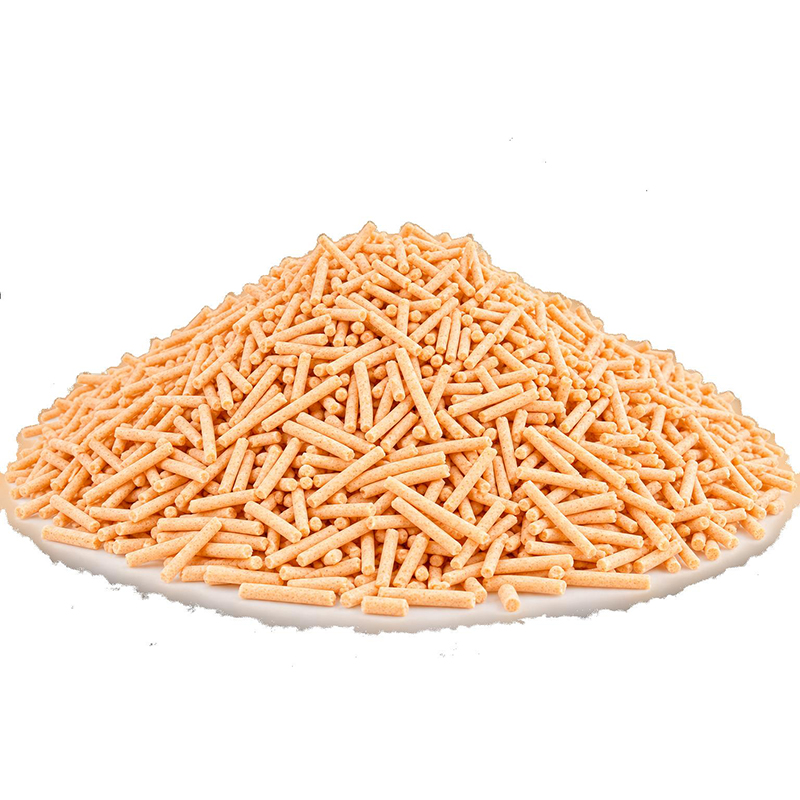
Tofu cat litter is often selected by consumers seeking an alternative to traditional clay litter. Plant-derived materials can provide a different handling experience and may be lighter than some mineral-based products, depending on the formulation and packaging.
The phrase “plant-based” does not automatically mean that every ingredient is natural, biodegradable, compostable, or environmentally preferable under all conditions. Buyers should confirm the ingredient list and obtain supporting documentation for any environmental claims.
The fragrance differentiates this product from unscented tofu cat litter and other fruit-inspired varieties. It may appeal to customers who prefer a recognizable fragrance in the litter box area.
Nevertheless, fragrance is not a substitute for regular scooping, suitable ventilation, or cleaning the litter tray. Effective odor management depends on the litter’s absorption performance, the frequency of waste removal, and the cleanliness of the surrounding environment.
Many tofu cat litter formulations are designed to form clumps after absorbing urine. Firm clumps can make it easier to remove wet litter without discarding large quantities of clean pellets.
For product evaluation, buyers should examine whether clumps remain intact during scooping, whether they stick to the bottom of the tray, and whether small fragments are left behind. These practical details can influence customer satisfaction and product consumption.
Pellet size, density, surface texture, and mechanical durability affect how tofu cat litter behaves during transport, pouring, and daily use. Pellets that resist excessive breakage may produce less loose material during handling.
However, no litter should be described as completely dust-free without reliable testing under defined conditions. Dust performance can vary with production, packaging, transport, storage, and use. A useful evaluation measures dust generation after the product has been handled or poured, rather than relying only on its appearance in an unopened bag.
Clumping plant-based litter may simplify the removal of urine clumps and solid waste. The used material can usually be collected with a scoop and placed in accordance with local waste-disposal rules.
Even when a product is marketed as flushable, it should not be flushed unless the manufacturer provides clear, substantiated instructions and local plumbing and wastewater rules permit it. Plant-based composition alone does not establish flushability.
Persimmon-flavored tofu cat litter may provide several practical advantages when its formulation is suited to the household and the cat accepts the fragrance.
A recognizable fragrance option: Persimmon-inspired scent adds variety to the Scented cat litter category and may appeal to buyers looking for alternatives to floral, herbal, or conventional fragrance profiles.
Plant-based litter choice: The use of plant-derived materials offers an alternative to mineral-based litter. Customers can compare ingredient composition, handling characteristics, and disposal requirements to determine whether it suits their preferences.
Convenient clump removal: In a well-performing clumping formula, wet litter can be removed in concentrated clumps, helping preserve unused material in the tray.
Potentially manageable handling weight: Some tofu litter products are relatively lightweight compared with certain clay litters. The actual difference depends on pellet density, moisture content, and package size, so buyers should compare net weight and volume rather than assuming all plant-based litters are lighter.
Product variety for retail channels: For pet retailers and online stores, a persimmon-inspired fragrance can expand a tofu cat litter assortment and provide another option for consumers who compare products by scent, materials, packaging, and cleaning performance.
These benefits should be confirmed against the specific product’s formulation and test results. They are not guaranteed for every persimmon-flavored tofu cat litter.
Different cat litter materials have different performance characteristics. The most suitable option depends on the cat’s preferences, household cleaning routine, budget, and disposal requirements.
| Comparison factor | Persimmon-flavored tofu cat litter | Bentonite clay litter | Silica gel litter | Paper cat litter |
|---|---|---|---|---|
| Main material | Typically plant-derived fibers and binders; verify the formula | Mineral clay | Porous silica material | Processed paper fibers |
| Fragrance | Persimmon-inspired scent, depending on formula | Unscented or scented options | Unscented or scented options | Often unscented, with some scented products |
| Clumping | Common in clumping tofu formulas | Common in clumping varieties | Usually non-clumping, though products vary | Depends on the formulation |
| Handling | Pellet size and durability vary | Often granular | Usually granules or beads | Often pellets or soft granules |
| Waste removal | Clumps can be scooped when the formula supports clumping | Clumps are scooped in clumping products | Solid waste is removed; product replacement follows instructions | Depends on whether the product clumps |
| Dust | Must be verified through testing | Varies by formulation | Varies by product and handling | Varies by paper processing and pellet durability |
| Environmental claims | Require ingredient and disposal evidence | Mineral-based; extraction and disposal matter | Product-specific material and disposal considerations | Paper sourcing and processing matter |
| Best evaluation criteria | Absorption, clump strength, scent acceptance, dust, pellet durability | Clump performance, dust, tracking, and cost | Moisture management, replacement interval, and cost | Absorption, softness, durability, and cleaning needs |
This comparison describes general product categories, not guaranteed performance. Formulation differences within each category can be substantial.
Absorption and clumping are two of the most important performance factors for tofu cat litter. Buyers should request clear testing methods and compare results from products evaluated under similar conditions.
Absorption capacity indicates how much liquid a defined quantity of litter can take up under specified test conditions. Results may vary depending on the liquid used, contact time, temperature, pellet size, and test procedure.
A useful evaluation should record:
The initial dry sample weight.
The type and amount of test liquid.
The contact time before measurement.
The final sample weight or calculated absorption result.
The amount of free liquid remaining after the test.
Whether the pellets retain their structure after absorption.
For a reliable comparison, all candidate products should be tested using the same procedure. A higher laboratory absorption value does not necessarily mean a product will provide the best real-world performance, so tray-based evaluation is also important.
Clump strength affects whether wet litter can be removed cleanly. Weak clumps may break apart during scooping and leave residue in the litter box. Clumps that adhere strongly to the tray bottom may also increase cleaning effort.
A practical test can assess whether clumps remain intact after a defined resting period and a consistent scooping procedure. Record the number of fragments, residue left in the tray, and the ease of removal. The test conditions should be kept consistent when comparing products.
Pellet durability influences how much material breaks down during packaging, shipping, pouring, and use. Excessive breakage may increase fine particles and alter the texture of the litter.
Manufacturers can evaluate durability by measuring fines before and after a defined handling process. Retail buyers should also inspect the product after transport and check whether the material remains reasonably consistent throughout the bag.
Odor control depends on moisture absorption, waste removal, tray cleanliness, ventilation, and any odor-control ingredients in the formula. Fragrance can change the perceived smell, but it does not necessarily eliminate the compounds responsible for unpleasant odors.
A useful odor evaluation should distinguish between masking odors with fragrance and reducing odor formation or release. Product claims should be supported by a defined test method and should not imply that routine cleaning is unnecessary.
Fragrance is a major point of differentiation for persimmon-flavored tofu cat litter, but it should be treated as a preference and formulation factor rather than an automatic benefit for every cat.
Cats may respond differently to scented litter. Some accept a lightly scented product without difficulty, while others may avoid it or show changes in litter-box behavior. A strong fragrance can also be unpleasant in a small or poorly ventilated room.
When introducing a new scented litter, consider the following practices:
Check the ingredient information. Confirm the fragrance components and follow the manufacturer’s handling instructions.
Introduce the product gradually. If the cat is accustomed to another litter, mix a small amount of the new product with the existing litter and increase the proportion only if the cat continues to use the tray normally.
Observe behavior. Watch for litter-box avoidance, excessive sneezing, visible irritation, or other unusual changes. Stop using the product and seek veterinary advice if concerning symptoms persist.
Maintain ventilation. Keep the litter area appropriately ventilated and remove waste regularly.
Provide an alternative when needed. An unscented product may be a better choice for cats that dislike fragrance.
For households with kittens, senior cats, or cats with known respiratory sensitivities, product selection should be especially cautious. Check the product’s age guidance and consult a veterinarian when a cat has a relevant health concern.
Selecting a suitable product requires more than comparing fragrance names. Buyers should assess performance, compatibility, packaging, and total cost of use.
Confirm the principal plant-based materials, binding agents, fragrance ingredients, and any additional functional components. Do not assume that the product contains actual persimmon fruit simply because the name includes “persimmon-flavored.”
For wholesale procurement, request an ingredient declaration and relevant safety documentation. Documentation requirements may differ by market and product classification.
Pellet dimensions can affect pouring, absorption, tracking, and a cat’s willingness to use the litter. Smaller pellets may behave differently from larger cylindrical pellets or other shapes.
A sample trial can help determine whether the texture suits the cat and whether the litter scatters excessively around the tray. The best pellet design depends on the formula and the intended user group.
Evaluate absorption speed, clump cohesion, residue, and ease of scooping. Consider both a controlled test and several days of normal use. A product that performs well in a single demonstration may behave differently under routine household conditions.
The persimmon scent should be noticeable enough to match the product positioning without being unnecessarily strong. Fragrance intensity can change during storage, so samples should be evaluated after being kept under representative conditions.
Observe dust during pouring and normal use. Check how much material is carried out of the litter tray and whether the pellets break down over time. A litter mat and suitable tray design may help reduce tracking, but results depend on pellet shape and the cat’s habits.
The lowest price per bag does not always represent the lowest overall cost. A useful comparison considers the amount required to fill the tray, how often litter must be replaced, the quantity removed during scooping, and the packaging size.
For commercial buyers, compare the delivered cost per kilogram, freight, packaging, expected product loss, and the amount of product needed to meet the intended performance standard.
A product specification sheet helps distributors, retailers, and private-label buyers compare persimmon-flavored tofu cat litter consistently. The values below are a template, not verified specifications for a particular product. Manufacturers should fill in the actual values based on product records and test results.
| Specification | Information to confirm |
|---|---|
| Product name | Persimmon-Flavored Tofu Cat Litter |
| Main materials | Confirmed plant-derived fibers and other ingredients |
| Fragrance type | Persimmon-inspired fragrance; disclose relevant details as required |
| Pellet shape | Cylindrical, granular, or other confirmed design |
| Pellet dimensions | Actual measured range |
| Color | Actual product appearance |
| Moisture content | Verified test result |
| Liquid absorption | Result with test method and units |
| Clump strength | Test method and measured result, if applicable |
| Dust or fines | Defined test method and result |
| Packaging options | Confirmed retail and bulk package sizes |
| Shelf life | Supported by stability data |
| Storage conditions | Manufacturer-approved conditions |
| Disposal guidance | Product-specific instructions and local requirements |
| Customization | Available fragrance, packaging, pellet, or formula options, if offered |
Quality control should cover incoming materials, production, fragrance consistency, pellet formation, packaging, and finished-product inspection.
Incoming material inspection: Verify material identity, condition, and supplier documentation. Check for contamination, excessive moisture, and other deviations that could affect production.
Process control: Monitor mixing, pellet formation, drying, and screening where these operations are part of the manufacturing process. Consistent processing helps reduce variation in pellet size and product handling characteristics.
Fragrance consistency: Confirm that the fragrance profile remains within the agreed specification. Where relevant, control the amount of fragrance added and document the process to help maintain batch consistency.
Finished-product testing: Evaluate moisture content, pellet dimensions, appearance, dust or fines, absorption, clump performance, and package integrity according to the product specification.
Packaging inspection: Check bag sealing, label accuracy, net weight, batch identification, and shipping protection. Packaging should help limit moisture exposure and prevent avoidable damage during transport.
Traceability: Maintain appropriate batch records and inspection documentation so that quality concerns can be investigated efficiently.
The exact inspection plan should reflect the product formulation, production process, intended market, and customer requirements.
Packaging affects product protection, shipping efficiency, shelf presentation, and the consumer’s ability to handle the litter. Persimmon-flavored tofu cat litter can be positioned for different sales channels, subject to the manufacturer’s available packaging capabilities.
Smaller bags may suit individual cat owners, trial purchases, and online retail. Useful packaging information includes the product name, net weight, ingredient information, fragrance description, directions for use, storage guidance, and disposal instructions.
Packaging claims such as “low dust,” “flushable,” “biodegradable,” or “safe for all cats” should only be used when adequately substantiated and appropriate for the target market. Avoid absolute claims that cannot be supported.
Larger packages may be suitable for pet shops, distributors, grooming businesses, boarding facilities, and other commercial customers. Bulk packaging should balance cost efficiency with manageable handling and protection against moisture and damage.
For shipping, buyers should assess carton dimensions, pallet configuration, gross weight, bag strength, and the likelihood of crushing or leakage during transit.
For brands planning to launch a persimmon-inspired tofu cat litter product, private-label or OEM/ODM arrangements may provide flexibility in packaging design and product positioning. Actual options depend on the manufacturer’s capabilities and minimum order requirements.
Before confirming a project, buyers should clarify:
Available base formulations and fragrance options.
Whether fragrance intensity can be adjusted.
Available pellet sizes and shapes.
Retail bag and bulk packaging choices.
Minimum order quantity and production lead time.
Artwork, labeling, and language requirements.
Sample approval and quality acceptance criteria.
Batch traceability and complaint-handling procedures.
Required documentation for the destination market.
A signed product specification and approved sample can help reduce misunderstandings between the buyer and manufacturer.
Store tofu cat litter in a dry, clean location and follow the manufacturer’s recommended storage conditions. Keep unopened bags protected from moisture, direct contamination, and physical damage. After opening, reseal the package where possible to help maintain product condition.
Moisture exposure may affect pellet integrity, handling, and clumping behavior. For bulk buyers, warehouse stock rotation and routine packaging inspection can help identify damaged or compromised bags before distribution.
Avoid creating unnecessary dust while pouring or transferring litter. Follow product-specific handling instructions, particularly when dealing with fragrance ingredients or any materials identified in the safety documentation.
Keep litter and packaging away from young children and pets that may chew or ingest non-food products. Cat litter is intended for litter-box use, not consumption.
Remove used litter according to the product instructions and local waste-disposal rules. Even if the litter is made primarily from plant-derived materials, used litter contains animal waste and may not be suitable for composting or disposal in every waste stream.
Do not assume that a tofu cat litter product is flushable. Plumbing systems, wastewater regulations, and product formulations differ. Unless the manufacturer provides substantiated flushability instructions and local rules permit it, dispose of used litter through an approved waste route.
Environmental performance should be evaluated using the complete product and its disposal pathway, rather than relying on a plant-based label alone.
Persimmon-flavored tofu cat litter may be suitable for several retail and commercial contexts, depending on its tested performance and fragrance characteristics.
Household cat owners: Consumers seeking a plant-based litter option with a fruit-inspired fragrance may consider this product if their cats accept scented litter.
Multi-cat households: Larger-volume packaging and effective clump removal may be useful where litter-box maintenance is frequent. Buyers should assess odor management and replacement costs under actual household conditions.
Pet supply stores: A persimmon-inspired fragrance can add variety to an existing tofu cat litter range. Clear product information helps customers compare fragrance, material, pellet shape, and package size.
E-commerce retailers: Online listings can explain the formula, usage instructions, tested performance, and packaging options. Product images should accurately represent the pellets and package rather than imply unverified features.
Distributors and importers: Consistent specifications, stable production, appropriate labeling, and reliable packaging are important when evaluating a product for repeat orders.
Private-label brands: A differentiated fragrance may support a broader assortment, provided that the formula, label claims, packaging, and customer expectations are aligned.
It is generally a plant-based cat litter made from materials such as soybean-derived fibers, other vegetable fibers, starches, or suitable binders. A persimmon-inspired fragrance may be added. The exact ingredients vary by product, so buyers should consult the manufacturer’s ingredient declaration rather than assume a standard formula.
Not necessarily. “Persimmon-flavored” may describe the fragrance profile rather than the presence of persimmon fruit. Check the ingredient list and ask the manufacturer for clarification if actual fruit-derived ingredients are important to your purchasing decision.
Many tofu cat litter products are designed to clump when they absorb urine. However, clumping performance depends on the specific formula and manufacturing process. Check the product instructions and evaluate clump strength, residue, and ease of scooping before making a bulk purchase.
Fragrance may change the perceived smell, but it does not automatically eliminate odor-causing compounds. Odor management also depends on absorption, regular waste removal, tray cleaning, and ventilation. Any specific odor-control performance claim should be supported by relevant testing.
No single litter type is suitable for every cat. Some cats accept scented litter, while others prefer unscented products. Introduce a new litter gradually and observe your cat’s behavior. If the cat avoids the tray or develops concerning symptoms, discontinue use and seek veterinary guidance when appropriate.
Dust levels depend on the formulation, pellet durability, screening process, transport, and handling. The product should only be described as low-dust when supported by a defined test method or reliable test data. Buyers can request a test report and inspect samples after pouring.
Do not assume that it can. Flushability depends on the exact product, plumbing system, and local regulations. Follow the manufacturer’s explicit instructions and local requirements. If flushability has not been substantiated, use an approved waste-disposal method.
Plant-derived materials may be capable of biological degradation under certain conditions, but the finished product’s behavior depends on its complete formulation and the disposal environment. Used litter also contains animal waste. Do not assume that it is suitable for home composting or municipal organic-waste collection without appropriate confirmation.
The required maintenance schedule depends on the product instructions, number of cats, litter-box size, and how well the litter absorbs liquid and forms clumps. Remove solid waste and used clumps regularly, replenish litter as needed, and replace and clean the tray according to the manufacturer’s directions and household conditions.
Keep it in a dry, clean place, protected from moisture and contamination. Reseal opened packages when possible and follow the manufacturer’s storage and shelf-life guidance. For commercial inventories, inspect packaging and rotate stock according to the applicable procedures.
Wholesalers should compare ingredient declarations, absorption and clump test results, dust performance, fragrance consistency, pellet dimensions, packaging, minimum order quantities, lead times, delivered cost, and documentation for the destination market. Request samples and approve a written specification before placing a large order.
Customization may be available depending on the manufacturer’s capabilities. Possible areas to discuss include fragrance intensity, pellet size, packaging format, label design, and product positioning. Buyers should confirm minimum order quantities, sample approval procedures, production lead times, and quality standards before finalizing a project.
Persimmon-flavored tofu cat litter combines the plant-based positioning of tofu litter with a distinctive fruit-inspired fragrance. Its suitability depends on practical performance, including liquid absorption, clump strength, pellet durability, dust generation, odor management, and whether individual cats accept the scent.
For consumers, the most useful approach is to review the ingredient information, introduce the product gradually, and follow the manufacturer’s maintenance and disposal instructions. For retailers, distributors, and private-label buyers, consistent specifications, verified quality data, appropriate packaging, and substantiated product claims are central to evaluating a reliable supply option.
By assessing these factors together, buyers can make a more informed decision about whether persimmon-flavored tofu cat litter fits their household needs or product portfolio.
邮箱

本网站使用 cookie 来确保您在我们的网站上获得最佳体验。

 English
 Pусский
 Deutsch
 العربية


 Whatsapp
 电话
 邮箱
 留言